


PRCAI latest SPRINT 2026 report estimated that the Indian PR industry grew 11% in FY26 to reach ₹3,230 crore, accounting for 12.6% of the Asia-Pacific market and it’s expected to reach ₹4500 crore by 2030.
The survey was conducted by Ipsos, a global market research and advisory company and PRCAI in collaboration with Astrum Reputation Advisory, a science based reputation advisory covering senior decision-makers from consultancies and corporate communication teams, and mid to senior level industry professionals.
The findings shows that, per respondents, annual growth has dropped below a CAGR 12% for the first time in a decade. The findings are based on 143 responses via a survey conducted Jan to March 2026.
Additionally, IPSOS analysed 90 annual reports of PR agencies for year FY25. This means the forecast is based on figures from April 2024 to March 2025.
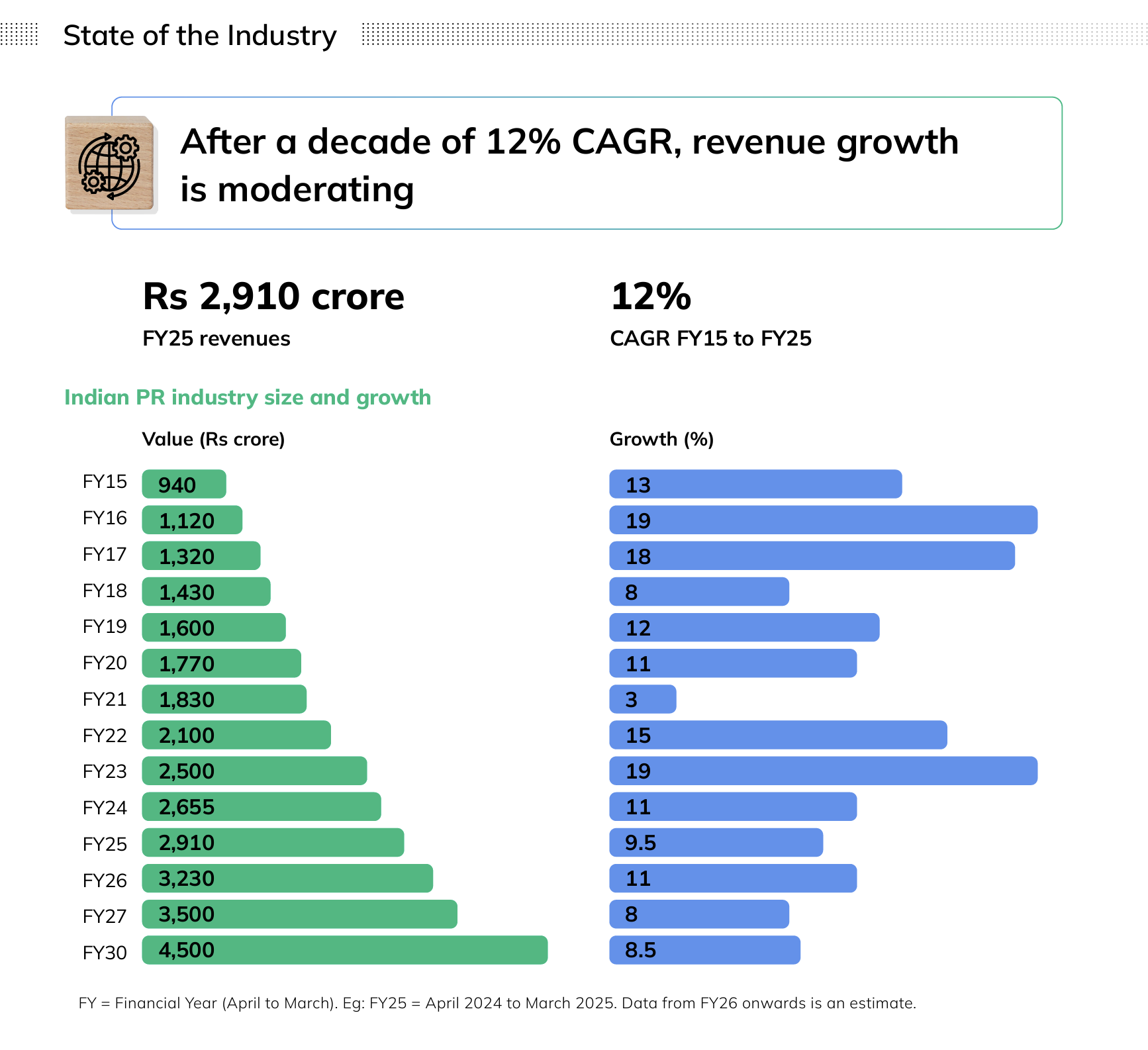
“The Public Relations industry in India is at an inflection point. While the sector delivered double-digit growth of 11% in FY2026, the moderation from its decade-long CAGR of 12% reflects a maturing industry, in line with global trends.
At the same time, "Nearly half of respondents believe PR directly drives business outcomes, while over 40% say CEOs are increasingly seeking strategic counsel from communications advisors. As AI reshapes the industry and trust becomes more critical than ever, PRCAI remains committed to advancing the profession through research, upskilling, and higher industry standards," concluded Deeptie Sethi, CEO, PRCAI.
Who are the top clients for Indian PR services?
SPRINT 2026 shows, the most striking shift is that Government's share of top client categories has nearly tripled since 2022 to 2026, from 4% to 11%, even as private corporates that long the industry's mainstay, slipped from 48% to 42% over the same period.
Start-ups have nearly quadrupled their share, from 6% to 22% over the same period. Overall, start-ups, education and ed-tech, Government and FMCG are the strongest sectoral gainers.
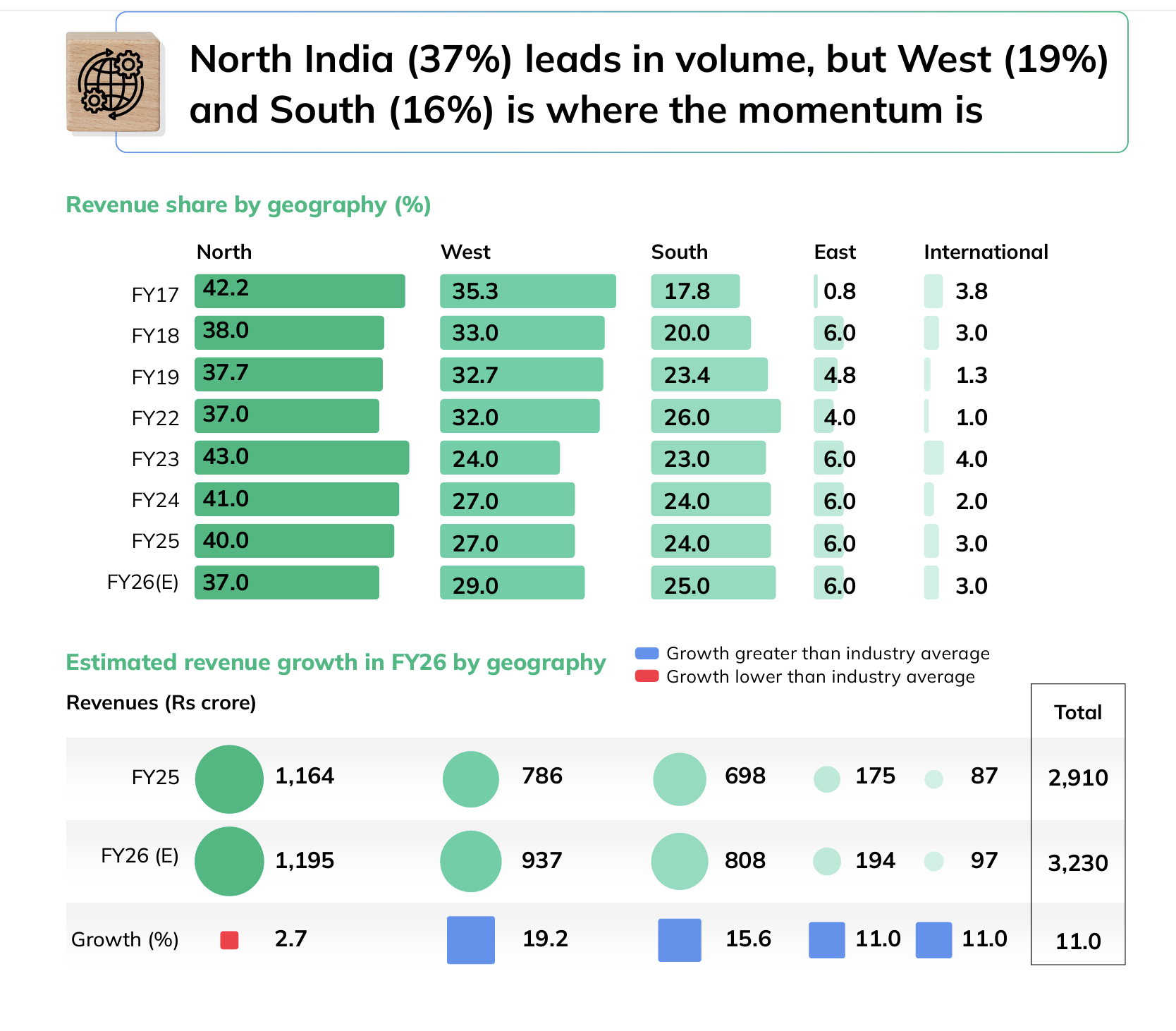
North India continues to dominate market size, the growth in demand from the Government for PR services perhaps contributing to that. Though west and South India , specially the west shows strong annual growth forecasts.
Which PR firms control the market?
12 PR firms control 70% of the market, but mid-sized firms are growing the fastest (at 16%). Giant firms consistently report the highest margins, even as industry EBITDA and PAT margins moderated in FY25.
"The RoI of Reputation Reputation creates a competitive advantage that positions a company favourably with all its constituencies and acts as a shield for value protection in a permacrisis world. There is enough data to prove that Reputation as an intangible asset accounts for a significant part of the firm’s market capitalisation. It enhances the success of major strategic initiatives like IPOs, M&As and other change initiatives", says Madan Bahl, co-founder & managing director, Adfactors PR
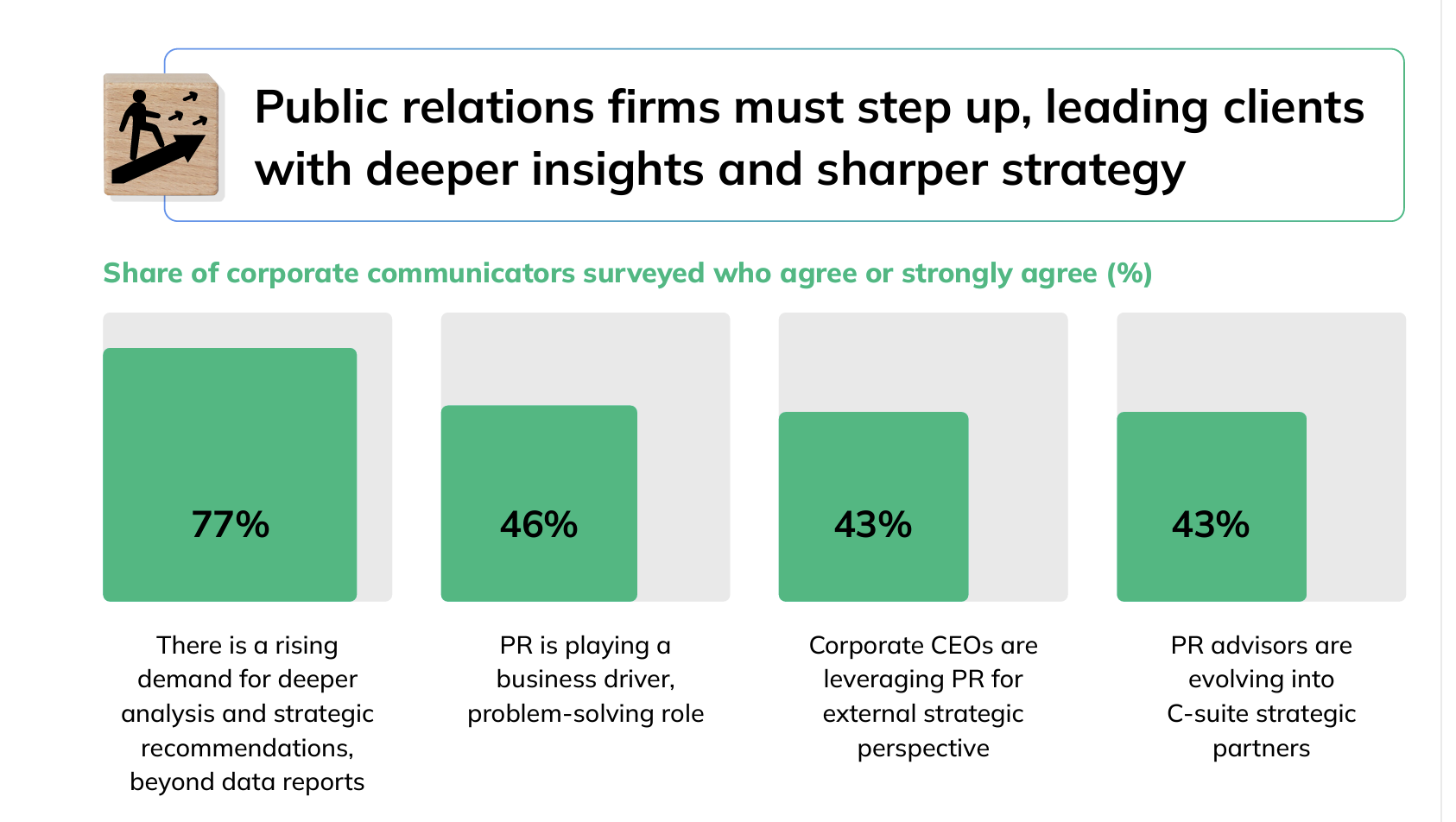
The role of PR is also becoming increasingly strategic and central to organizations. 46% of communicators now say public relations plays a direct role in driving business outcomes, and more than 40% report that CEOs are actively seeking external strategic counsel from their communications advisors.
“PRCAI SPRINT 2026 reveals that there is no longer a single story defining the Indian PR industry. There are several, and they are diverging rapidly. As expectations from communications continue to evolve, the profession must sharpen its strategic capabilities, adopt emerging technologies responsibly, and reinforce its role as a trusted business partner", said Kunal Kishore, president, PRCAI.
The report’s findings suggest key shifts underway in the PR industry: reputation is now valued as a driver of business rather than a value add; AI is fragmenting into divergent strategies rather than a single playbook; the rules of brand discovery are being rewritten by Large Language Models (LLMs), with earned media, regional PR and influencers all growing in significance; and the profession's client base, operating model and talent are being reshaped.
Reputation Moves from Problem-Solver to Business Driver
The evidence behind reputation's business value is compelling: 96% of corporate communication respondents agree PR helps build investor confidence, an equal share credit it with customer loyalty, 92% believe it aids strong stakeholder relations, 83% say it increases crisis resilience, and 75% concur it drives long-term revenues. As the boundary between PR and broader marketing dissolves, PR's share of marketing budgets has risen from 12% in FY25 to 14% in FY26, with 58% saying PR's role is expanding into marketing-performance outcomes and 53% saying it is gaining share from ad and digital agencies.
In order to maintain this the report says public relations firms must step up, leading clients with deeper insights and sharper strategy.
"PR will build trust by anticipating risks, navigating stakeholders PR advisors are evolving into C-suite strategic partners Communications is at an inflection point. As the SPRINT findings indicate, the role is rapidly evolving from narrative building to shaping business outcomes. In an environment defined by policy shifts, technological disruption, and rising stakeholder expectations, the value of communications will be measured by its ability to anticipate risk, guide leadership, and build trust. The opportunity ahead is clear but so is the responsibility. We must move beyond execution to strategic advisory and ensure we are not just part of the conversation, but helping define it", says Abhishek Gulyani, managing director India and head of corporate affairs APAC, Zeno Group; national chair talent & academia, PRCAI
Same AI, Different Plays: PR Firms of Different Sizes Are Making Entirely Different Bets
Across ten distinct functions where AI is now deployed in Indian PR, research and intelligence gathering leads at 77%, ahead of written content creation (73%), note-taking and meeting summarisation (66%), and visual content, ideation and content versioning (55% each).
The deeper story is in how differently firms invest: 90% of mid-sized firms name training and upskilling their top AI priority; 78% of emerging firms prioritise AI-enhanced creative tools and 65% third-party platforms like ChatGPT, Gemini and Copilot; while 68% of giant and large firms prioritise AI-driven data analytics and 73% prioritise upskilling. Overall, AI investment as a share of revenue has tripled, from 2% three years ago to 7% in 2026, and is projected to reach 10% within three years.
The industry is clear-eyed about the risks. Fake-news incidents reported by corporate communicators nearly doubled, from 28% in 2024-25 to 46% in 2025-26; 80% now flag AI-generated misinformation and deepfakes as a top reputational risk, and 61% warn AI is commoditising creativity. 85% expect AI-governance frameworks to become mandatory, not as a constraint, but as the route to resolving the transparency crisis AI itself has created. The next competitive advantage, the report suggests, lies in the disciplined integration of AI with human judgement.
Earned Media's Golden Age: LLMs, Regional Media and Influencers Rewrite the Playbook
Large Language Models have become the new gatekeepers of brand discovery: 83% agree earned media is gaining importance because LLMs prioritise credible, third-party sources over paid placements, and 70% say Generative Engine Optimization (GEO) is becoming a distinct PR strategy.
Regional India is no longer peripheral with regional PR's share of total industry revenue rising from 10% three years ago to 19% in 2026, projected to reach 25%, and 65% of corporate communicators naming Tier-2 cities as the primary growth engine.
Influencer marketing has matured into an accountability-first discipline, its revenue share doubling from 8% to 16% and projected to reach 22%, even as 98% of respondents demand greater verification and regulation of influencer content. The blurring of paid and earned is creating a parallel credibility crisis and 66% respondents agree that positioning paid content as earned is weakening audience trust.
The Measurement Paradox
Measurement remains the industry’s most stubborn contradiction. 92% of corporate communicators agree the Public Relations industry needs a clear, standardised measurement system, yet only 46% of corporate communication respondents allocate a separate budget for it, a gap that continues to limit Public Relations’ ability to prove its full business value.
The metrics themselves are shifting. While, share of voice remains the most widely used metric (84%), followed by social listening and sentiment analysis (57%) and engagement rates (54%), a new generation of metrics is rising fast. 50% of respondents now use brand reputation and trust scores, 41% use return on objective, and 27% use discoverability inside AI and LLM search, an early sign that whether a brand surfaces in an AI answer is becoming a measurable PR outcome.
When asked what PRCAI should build next, 83% of consultancy heads and 75% of corporate communicators put measurement standards at the top of the list.
If you enjoyed this article, you can subscribe for free to our weekly event and subscriber alerts.
We have four email alerts in total - covering ESG, PR news, events and awards. Enter your email address below to find out more: