

Thirty years ago, doing PR in India meant queuing for a shared fax machine, waiting out a screeching dial-up modem, and carrying your work around on a floppy disk between cyber cafés. The tools have changed beyond recognition. The fundamentals haven't.
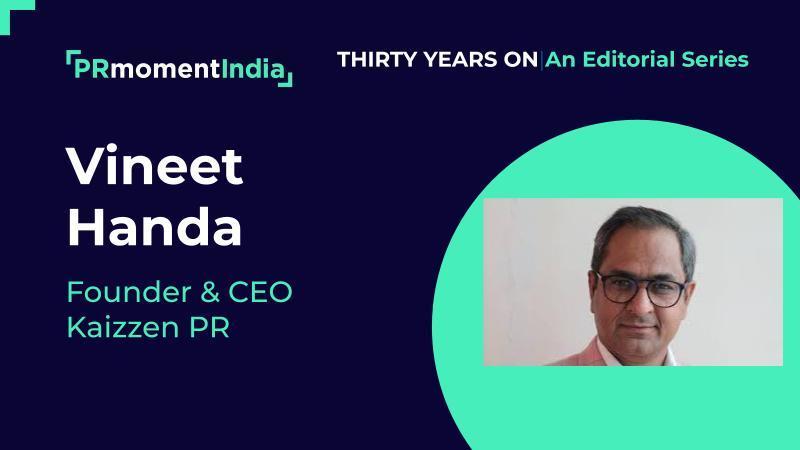
In the first episode of our Thirty Years On series — three decades of Indian PR, told by the people who built it — we sit down with Vineet Handa, founder & CEO of Kaizzen, who has lived the entire arc from the post-liberalisation boom to the age of AI.
He charts Kaizzen's growth from 34 people in 2020 to over 250 today, and makes the case that while the toolkit has been transformed, the real drivers of success have barely moved.
Vineet also talks about his journey from Chhindwara to the global PR stage, why the English grammar classic Wren and Martin was his companion in the early days of PR and how he had a challenge convincing people to work with his in the initial days of Kaizzen
Listen in.
Key Takeaways
1. The productivity paradox: Why technology made us "Lazy"
Vineet recalls spending 15 out of 22 working days a month on the road, meeting journalists face-to-face. It kept practitioners "on top" of their beats and deeply attuned to the nuances of every newsroom.
Today, technology has removed the friction, but it has also introduced a productivity paradox. While we can blast a release to hundreds in seconds, the industry has become "lazy" regarding real-world engagement. Many professionals today couldn't pick their key journalists out of a lineup.
2. The rise of "relationship capital" as the ultimate asset
As we integrate AI into every facet of our work, Vineet identifies "Relationship Capital" as the industry's most valuable currency for 2030. This capital is the accumulated depth of trust and genuine connection between an agency, its clients, and the media.
3. Why you shouldn’t manipulate the AI filter
The current trend in PR is a scramble for "AI Engine Optimization" (AEO)—an attempt to trick models like Claude or ChatGPT into favoring certain brands. Vineet argues that this is a fool’s errand. Instead, he advocates for radical authenticity.
He shares the story of a recent high-stakes pitch where AI "Claude" played a role in his win.
4. The "small-town" advantage
The future of Indian PR is being written by talent from non-metro cities like Chhindwara, Madhya Pradesh—Vineet’s own hometown. He credits his "self-reliance" to a school system where teachers might finish a 12-chapter course in four days, effectively forcing students to find their own way.
Vineet’s story also highlights a critical lesson in lifelong learning: even as a veteran, he recognized the need to sharpen his tools, undergoing a three-month intensive English training program mid-career and revisiting the classic Wren & Martin grammar foundations.
"I know for sure if I'm not doing this, I'm probably be a farmer... the people coming from small towns have that hunger, that zeal to do things."
5. Mentors
He identifies his own mentors—Prema Sagar, Samir Kale, Ashwani Singla, as the pillars of his career.
He also argues that tough bosses provide the maximum learning because they demand the "patience and persuasion" required to master the craft.
If you enjoyed this article, you can subscribe for free to our weekly event and subscriber alerts.
We have four email alerts in total - covering ESG, PR news, events and awards. Enter your email address below to find out more: